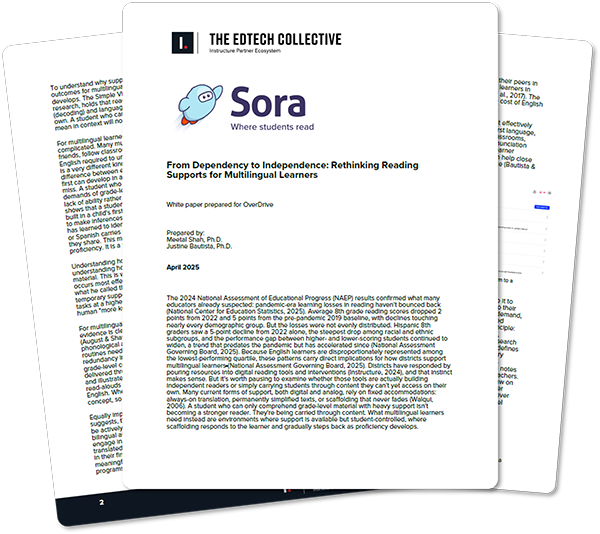
From Dependency to Independence
Rethinking Reading Supports for Multilingual Learners
Inside the white paper
Prepared by researchers at Instructure Meetal Shah, Ph.D. and Justine Bautista, Ph.D., this paper synthesizes literacy research, second-language acquisition theory, and classroom evidence — and it starts with a difficult statistic: Hispanic 8th graders saw the steepest reading decline among racial and ethnic subgroups on the 2024 National Assessment of Educational Progress (NAEP), and are disproportionately represented among the lowest-performing students. This paper asks whether the tools districts are leaning on are actually closing reading gaps, or merely papering over them.

Support that never fades isn't support
Many digital reading tools offer the same accommodations: always-on translation, permanently simplified texts, or scaffolding that never fades. Often, these tools are only carrying students through content instead of building their capacity to access it on their own. This paper unpacks why fixed supports fail multilingual learners, and what effective scaffolding looks like instead.

The fluency gap you might be overlooking
The student who sounds conversationally fluent in your school's hallways may still be years away from the academic language proficiency that grade-level texts demand. This paper explains why this gap is easy to miss, why it's often mistaken for a lack of ability rather than an ongoing process of language development, and how long it actually takes to close.

What "good scaffolding" actually requires
Temporary. Fading. Student-controlled. The evidence base for what effective support looks like for multilingual learners is strong — and it's worth a pause to consider whether or not the tools your district is using meet it. This paper maps out the research principles and dives into what they require in practice.

Sora features backed by evidence
Not to be missed: a feature-by-feature map of how Sora addresses six research-backed principles for multilingual learner literacy — from translanguaging support to reading analytics that can help teachers determine when it might be time to reduce scaffolds.
Why this matters
5-point drop
5–7 years
7–9 months
See how your supports hold up
Download From Dependency to Independence for the full research base, the six principles, and the feature-by-feature map.