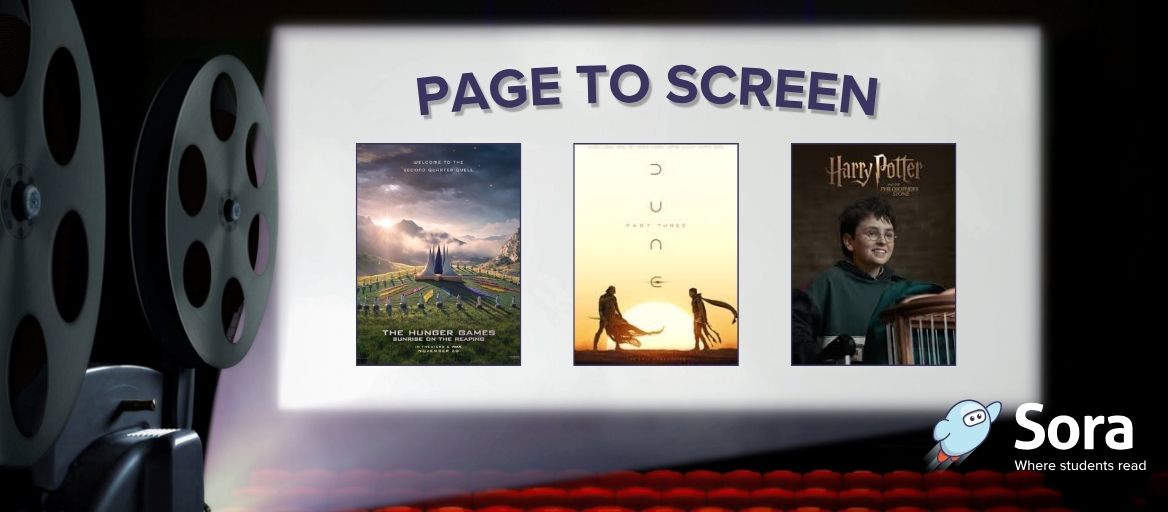
Screen-worthy stories: Fall & Winter 2026
Every time a beloved book gets the movie or TV treatment, students have opinions. They want to know who got cast, whether the adaptation will live up to the book, and—perhaps most importantly—whether they should read the book before they watch.
This fall and winter, there’s plenty to talk about. From Percy Jackson’s next quest to the return of Harry Potter, some of the biggest books in students’ libraries are headed to screens between now and New Year’s.
For educators, that creates an opportunity. Pop culture can be a surprisingly effective way to help students discover books they might not otherwise pick up. A movie or series can provide an entry point, a conversation starter, or even a little extra motivation to finish the book before the premiere.
Here are some of the adaptations to have on your radar—and ideas for using the buzz around them to connect students with reading.
Start with the stories students are already talking about

The Titan's Curse
by Rick Riordan
Also available as an audiobook 🎧
Season 3 — Streaming November 20
When students are already invested in a character or fictional world, finding the book can feel like the natural next step.
The third season of Percy Jackson and the Olympians will adapt The Titan’s Curse, giving middle grade readers another reason to revisit—or finally start—the series. For students who are watching the show, try using the upcoming season as a reading challenge: Can they read The Titan’s Curse before the new episodes arrive? Or invite students who have read ahead to share what they’re looking forward to seeing on screen without giving away too much.
It’s also a reminder that adaptations can be useful for helping students discover a series, even when the screen version is what catches their attention first.
Find even more resources at our sister brand TeachingBooks.

Harry Potter and the Sorcerer's Stone
by J. K. Rowling
Also available as an audiobook 🎧
Streaming Christmas Day
Few contemporary series have had a bigger impact on generations of young readers than Harry Potter. HBO’s new series offers another opportunity to introduce the story to students who may know the movies—or the characters and cultural references—but haven’t yet experienced the books.
Rather than treating the adaptation as a replacement for reading, use the renewed attention around the series as an invitation. Which characters are students curious about? What details from the book are they hoping to see? What might be different this time around?
For younger readers especially, a familiar pop-culture touchpoint can make a long book feel much more approachable.
Turn “I want to watch it” into “I want to read it first”
Sometimes the most effective reading motivation is a deadline students actually care about.

Sunrise on the Reaping
by Suzanne Collins
Also available as an audiobook 🎧
In theaters November 20
Suzanne Collins’s The Hunger Games prequel follows a teenage Haymitch during the Second Quarter Quell. With the film arriving in theaters, students who already know the franchise may be especially curious to see this part of Panem’s history.
For older students who are familiar with the series, the movie can create a natural reason to pick up the book before seeing it. Consider building a small “Read It Before You See It” display or recommendation list around the release, pairing Sunrise on the Reaping with the original Hunger Games trilogy for students who want to revisit Panem.
As with any title, be mindful of age appropriateness and the series' violence when recommending it to students.

Dune
by Frank Herbert
Also available as an audiobook 🎧
In theaters December 18
The Dune films have introduced a new generation of audiences to Frank Herbert’s sprawling science-fiction universe. For students who discovered Arrakis through the movies, that interest can be a bridge into the original books—or into other science fiction.
Students don't have to be ready to tackle the entire Dune series to benefit from the connection. Ask what they liked about the films, then use those interests to recommend books featuring expansive worlds, political intrigue, complex heroes, or futuristic societies.
The goal isn't necessarily to turn every movie fan into a Herbert reader. It's to use what already interests students as a starting point for their next book.
Give classic books a pop-culture entry point
Adaptations can also make older or challenging texts feel more immediate.

A Tale of Two Cities
by Charles Dickens
Also available as an audiobook 🎧
Streaming weekly through October
Charles Dickens isn't always the easiest sell to a modern classroom. A new adaptation, however, gives students a current cultural connection to a story they might otherwise encounter only as an assigned text.
As new episodes arrive, consider using them as a jumping-off point for discussion: What makes a story written centuries ago still resonate? How does seeing a character on screen change the way students imagine them on the page?

East of Eden
by John Steinbeck
Streaming October 1
John Steinbeck's East of Eden is another ambitious classic getting a high-profile adaptation, starring Florence Pugh. For students working through the novel, the series could offer another way to visualize its sprawling family story and explore its themes.
The same approach can work with other classics: don't position the adaptation as an easier alternative to the book. Use it to give students another lens through which to think about what they're reading.

Sense and Sensibility
by Jane Austen
Also available as an audiobook 🎧
In theaters October 16
Jane Austen's Sense and Sensibility follows the Dashwood sisters through love, money, family, and social expectations. For students encountering Austen's writing for the first time, a new adaptation can make those themes feel considerably less distant.
It can also open the door to conversations about adaptation itself. What gets changed when a narrator's words become dialogue? What does a filmmaker emphasize? What disappears?
Those questions turn watching into another way of engaging closely with a text.
Let students follow their interests
Not every reading connection needs to lead to a formal lesson. Sometimes, knowing what's capturing students' attention is enough to help you make a better recommendation.
Students who discover a story through a movie or TV series may be ready to explore the book, but their interests can also point toward something entirely new. A Percy Jackson fan might be ready for another mythology-inspired fantasy. A Hunger Games reader might want another dystopian series. A student drawn to the world-building in Dune might be ready to explore more science fiction.
The key is to follow the interest. Pop culture doesn't have to be the destination. It can be the trailhead to a new genre, author, series, or format.
You don't have to compete with what students are watching to get them reading. Instead, pay attention to what they're excited about—and use those interests to help them find what they might want to read next.
Looking for the big kids guide to upcoming adaptations? Check out what we're looking forward to over on Libby Life!
Published Sep 21, 2026

Maddi Hebebrand
Maddi Hebebrand is an integrated marketing specialist for Sora. When she's not working or reading, she can be found playing with her pets, attending local concerts, or spending time with friends and family. While Maddi loves reading across genres, some of her favorite titles include the Dungeon Crawler Carl series by Matt Dinniman, Mary by Nat Cassidy and Witchcraft for Wayward Girls by Grady Hendrix.