Not screen time, reading time
"Screen time" has become a catchall term for everything we do on a device. But reading an ebook, listening to an audiobook, watching a short video, scrolling social media, and playing a game are all very different experiences. The device may be the same, but what students are doing with it, and what they're getting from it, can be very different. Research on children and adolescents increasingly points to the limitations of treating all screen use as one category, with researchers noting that the content, context, task, and type of screen activity can matter when considering its relationship to learning and academic outcomes (Adelantado-Renau et al).
For educators, that distinction can be useful when talking with families about digital reading. Our goal isn't to dismiss concerns about screens, but to make room for more nuanced conversation about what students are using them for.
Not all screen time is the same
Some digital activities are primarily passive. Streaming videos, sifting through social media, and watching an endless queue of short-form content can be designed to keep users scrolling with little active participation.
Other activities ask us to do more. Reading an ebook requires attention and comprehension. Listening to an audiobook asks the user to follow a narrative, build understanding, and engage with language. Working through a tutorial, using a translation tool, or collaborating on a digital project are all ways students actively use technology to achieve learning goals.
When students open Sora to find a book, settle into an audiobook, or enjoy a read-along, the screen serves as a pathway to reading. And because Sora is designed specifically for schools, students aren't navigating ads, social feeds, or unrelated content while they're there.
That doesn't make every minute on a device inherently productive, but it does mean that "screen time" is a bit more complicated than we once thought.
What makes digital reading different?
There are several reasons digital reading can be a meaningful part of a student's reading life.
The focus is on the book. Sora gives students access to books and reading materials, both curricular and independent, in a school-focused environment without the distractions of advertising or social media feeds.
Students have choices. The ability to browse a digital collection and select titles that align with their interests, reading level, and lived experiences builds a student's agency, motivation, and ownership of their reading choices.
Different formats can support different readers. Some students prefer an ebook. Others connect with audiobooks or benefit from reading and listening at the same time. Offering multiple formats gives educators more ways to help students find an entry point into reading.
Digital tools can support access. Research on text-to-speech and related read-aloud technologies has found potential benefits for reading comprehension among students with varying needs, suggesting that technology can provide useful support when decoding presents a barrier to accessing text (Wood et al).
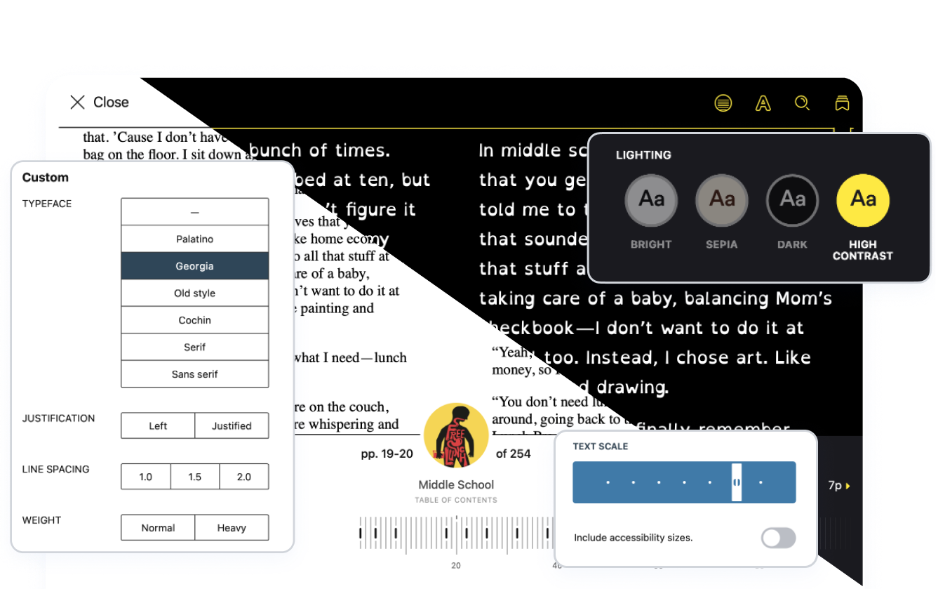
Reading can fit into more parts of the day. A book on a student's school-issued device can travel with them between classes, home, and school activities. Digital access can make it easier to keep a book within reach when a physical copy isn't available.
These are all different from the kinds of screen use that often drive concerns about excessive device time. The important distinction isn't simply whether a student is looking at a screen -- it's what they're doing there.
A different way to talk about screen time
Rather than treating all device use as one category, talk about the purpose behind it. A student reading a novel for 30 minutes is having a different experience from a student spending 30 minutes scrolling through social media. Both involve a screen, but the activity, level of engagement, and purpose are not the same.
The same logic applies to format, but it's worth pushing on a little further: it turns out format has surprisingly little to do with what actually drives reading outcomes. Reading science, including well-established frameworks like Scarborough's Reading Rope, points to a mix of factors that have nothing to do with paper versus pixels: the quality and complexity of the text, a student's background knowledge and vocabulary, their motivation to read in the first place, the instruction they receive, and the chances they get to talk about what they've read and actually use it. An ebook isn't automatically better because it's on a screen, and a physical book isn't automatically more meaningful because it's printed. Format is one ingredient, not the whole recipe.
That's also where direct instruction earns its place in this conversation. Comprehension isn't something students pick up automatically just by being handed a book, digital or otherwise. Students still need to be explicitly taught how to read closely, how to navigate and make meaning across formats, and the skills unique to each one — inferring tone from narration in an audiobook, say, or navigating hyperlinked or interactive text in an ebook. Digital reading doesn't remove the need for that instruction, it just adds a few new formats worth teaching into.
That fuller picture also helps sidestep a trap worth avoiding: positioning digital reading and print reading as rivals. Students benefit from having access to both, taught well. For some, digital formats make it easier to discover books, explore new genres, listen to stories, or fit reading into a busy day — but that's a case for access and flexibility, not proof the format itself is doing the heavy lifting.
Keep the focus on reading
Concerns about screen use aren't going away, and we don't need to dismiss them. But “screen time” is a broad category, and that ambiguity can obscure the abilities and access students gain with a digital reading option.
When screens help students discover a new book, follow an audiobook, read in a format that works for them, or spend time immersed in a story, it doesn't harm – it grows their world.
For more on digital reading and literacy, explore resources from OverDrive, including curriculum-aligned materials and research to help educators connect digital reading with classroom goals. Our sister brand, TeachingBooks, offers author interviews, discussion resources, and other materials that can help educators extend conversations around the stories students are already connecting with.
References
- Adelantado-Renau, Mireia, et al. “Association Between Screen Media Use and Academic Performance Among Children and Adolescents: A Systematic Review and Meta-analysis.” JAMA Pediatrics, vol. 173, no. 11, 2019, pp. 1058–1067. https://doi.org/10.1001/jamapediatrics.2019.3176
- Wood, Sarah G., et al. “Does Use of Text-to-Speech and Related Read-Aloud Tools Improve Reading Comprehension for Students with Reading Disabilities? A Meta-Analysis.” Journal of Learning Disabilities, vol. 51, no. 1, 2018, pp. 73–84. https://doi.org/10.1177/0022219416688170
Published Sep 30, 2026

Maddi Hebebrand
Maddi Hebebrand is an integrated marketing specialist for Sora. When she's not working or reading, she can be found playing with her pets, attending local concerts, or spending time with friends and family. While Maddi loves reading across genres, some of her favorite titles include the Dungeon Crawler Carl series by Matt Dinniman, Mary by Nat Cassidy and Witchcraft for Wayward Girls by Grady Hendrix.